
Title: Being Seen
Subtitle: One Deafblind Woman’s Fight to End Ableism
Author: Elsa Sjunneson
Other Contributors: N/A
Subject: Ableism, The Deafblind Experience, The Disabled Experience, Disabled Representation in Pop Culture and the Media
Publisher: S&S/Simon Element
Published: 2021
ISBN/DOI/EISBN: 978-1-9821-5240-6
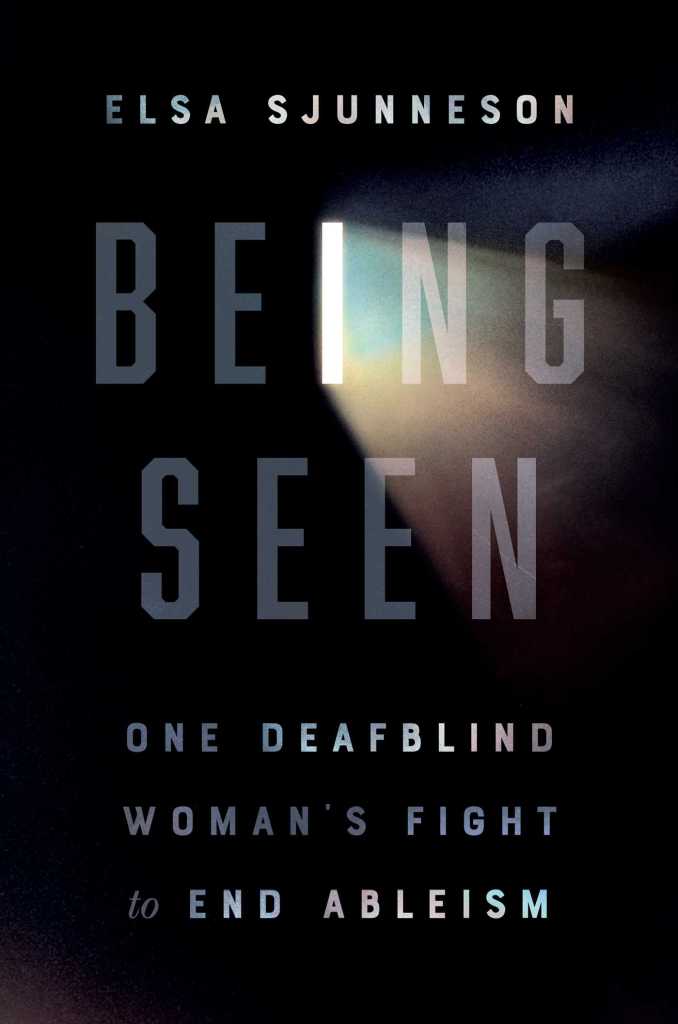
[ID: A book cover. It is a dark black with faint, grey, writing over it. The writing, from top to bottom, reads:
“Elsa Sjunneson”
“Being Seen”
“One Deafblind Woman’s Fight to End Ableism”
All in capitals. The “I” in “Being Seen” is designed to look like an opening of sorts, with a ray of light coming through. /end]
Content Warning:
- Ableism
- Police Brutality
- Depression
- Suicidal Thoughts
- Medically Assisted Suicide
- Eugenics
- References to Physical Assault
- References to Sexual Assault
Summary:
A deafblind writer and professor explores how the misrepresentation of disability in books, movies, and TV harms both the disabled community and everyone else.
As a deafblind woman with partial vision in one eye and bilateral hearing aids, Elsa Sjunneson lives at the crossroads of blindness and sight, hearing and deafness—much to the confusion of the world around her. While she cannot see well enough to operate without a guide dog or cane, she can see enough to know when someone is reacting to the visible signs of her blindness and can hear when they’re whispering behind her back. And she certainly knows how wrong our one-size-fits-all definitions of disability can be.
As a media studies professor, she’s also seen the full range of blind and deaf portrayals on film, and here she deconstructs their impact, following common tropes through horror, romance, and everything in between. Part memoir, part cultural criticism, part history of the deafblind experience, Being Seen explores how our cultural concept of disability is more myth than fact, and the damage it does to us all.
Notes:
This book may also be published under the name “Elsa Sjunneson-Henry”.
Archivist Comments:
Sjunneson is also an editor for Uncanny magazine (which I had suggested to me within days of this book), has several pieces of short fiction and non-fiction out, and has been a contributing writer and developer to several tabletop games.
This book has fairly high ratings. A lot of praise is directed towards the handling of serious topics, and the notes of humour that are sprinkled throughout. Also saw a comment praising the use of footnotes to add further definition and examples to what is being discussed.
 The Disability Book Archive
Leave a comment