
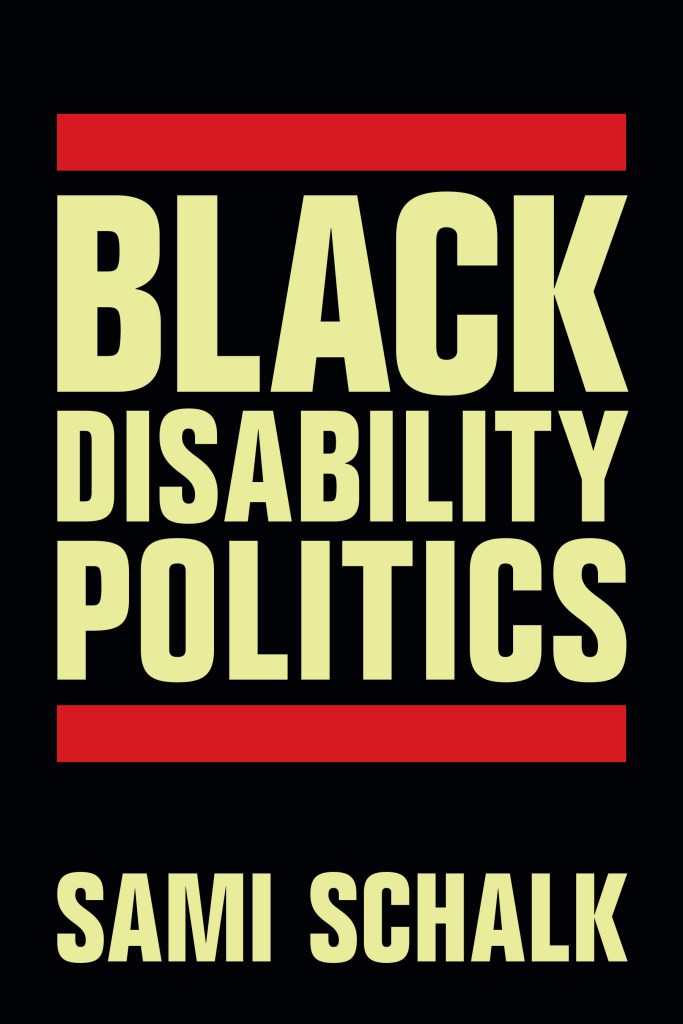
Title: Black Disability Politics
Subtitle: N/A
Author: Sami Schalk
Other Contributors: N/A
Subject: Disability, Race, Politics, Disability Studies, Healthcare, History
Publisher: Duke University Press Books
Published: 2022
ISBN/DOI/EISBN: 978-1-4780-9268-1
[ID: A book cover. The background is solid black. Large yellow writing can be seen across the first two thirds. It reads “Black Disability Politics” in all caps, with a red bar at the top of “black”, and a red bar below “politics”. Below the second bar, the author’s name, “Sami Schalk”, in a slightly smaller, yellow font, still in all caps. /end]
Content Warning:
- References to racism
- References to ableism
- References to sexism
- Discussions of HIV/AIDs
Summary:
In Black Disability Politics Sami Schalk explores how issues of disability have been and continue to be central to Black activism from the 1970s to the present. Schalk shows how Black people have long engaged with disability as a political issue deeply tied to race and racism. She points out that this work has not been recognized as part of the legacy of disability justice and liberation because Black disability politics differ in language and approach from the mainstream white-dominant disability rights movement. Drawing on the archives of the Black Panther Party and the National Black Women’s Health Project alongside interviews with contemporary Black disabled cultural workers, Schalk identifies common qualities of Black disability politics, including the need to ground public health initiatives in the experience and expertise of marginalized disabled people so that they can work in antiracist, feminist, and anti-ableist ways. Prioritizing an understanding of disability within the context of white supremacy, Schalk demonstrates that the work of Black disability politics not only exists but is essential to the future of Black liberation movements.
Notes:
You can find an open access version of this book here.
Schalk is a professor of Gender and Women’s Studies at the University of Wisconsin-Madison. She minored in Disability Studies, and conducts research focused on disability, race and gender in contemporary American literature and culture.
Archivist Comments:
I don’t normally link to the books, but I found an open access version of this and was very excited to share it. It should take you to the Duke Press site. If you’re wanting to know more about Schalk and her work, here is a link to her website.
 The Disability Book Archive
Leave a comment