
Title: Capitalism and Disability
Subtitle: Selected Writings by Marta Russell
Author: Marta Russell
Other Contributors: Keith Rosenthal (editor)
Subject: Disability, Capitalism, Disability Studies, History, Oppression, USA
Publisher: Haymarket Books
Published: 2019
ISBN/DOI/EISBN: 978-1-6084-6686-3
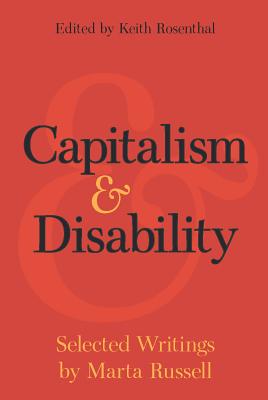
[ID: A book cover. The cover is red with text layered over it. The text, from top to bottom, reads:
“Edited by Keith Rosenthal”, in small, black font
“Capitalism & Disability” in large, black font in the centre. The “&” is in yellow.
“Selected Writings by Marta Russell”, at the bottom of the cover in small, yellow font.
Behind the title, a large, faint “&” can be seen. /end]
Content Warning:
- Discussions of politics
- Discussions of oppression
- Discussions of economy
- TBD
Summary:
This book comprises a collection of groundbreaking writings by Marta Russell on the nature of disability and oppression under capitalism.
Spread out over many years and many different publications, the late author and activist Marta Russell wrote a number of groundbreaking and insightful essays on the nature of disability and oppression under capitalism. In this volume, Russell’s various essays are brought together in one place in order to provide a useful and expansive resource to those interested in better understanding the ways in which the modern phenomenon of disability is shaped by capitalist economic and social relations. The essays range in analysis from the theoretical to the topical, including but not limited to: the emergence of disability as a “human category” rooted in the rise of industrial capitalism and the transformation of the conditions of work, family, and society corresponding thereto; a critique of the shortcomings of a purely “civil rights approach” to addressing the persistence of disability oppression in the economic sphere, with a particular focus on the legacy of the Americans with Disabilities Act of 1990; an examination of the changing position of disabled people within the overall system of capitalist production utilizing the Marxist economic concepts of the reserve army of the unemployed, the labor theory of value, and the exploitation of wage-labor; the effects of neoliberal capitalist policies on the living conditions and social position of disabled people as it pertains to welfare, income assistance, health care, and other social security programs; imperialism and war as a factor in the further oppression and immiseration of disabled people within the United States and globally; and the need to build unity against the divisive tendencies which hide the common economic interest shared between disabled people and the often highly-exploited direct care workers who provide services to the former.
Notes:
Before her death, Russell was a journalist, disability activist, and a participant in the Civil Rights movement.
Her book “Beyond Ramps: Disability and the End of the Social Contract” was published in 1998, and a second edition was published in digital format for the Amazon Kindle in 2016.
Also in 2016, in honour of Russell and her work, Routledge Press published an essay anthology titled “Disability Politics in a Global Economy: Essays in Honour of Marta Russell”. Numerous authors contributed to it, and it was released again in 2018, in paperback edition.
Russell and Ravi Malhotra (who would go on to edit both the 2016 collection of essays and the second edition of “Beyond Ramps”) co-authored a paper in 2002 titled “Capitalism and Disability”.
Archivist Comments:
I think this was the first non-fiction book that got suggested to me.
The book focuses on six areas of disability- political economy, civil rights, incarceration, social security, crisis, and death- with essays selected by Rosenthal. Now, the essays are from the period 1998-2005, but both Rosenthal and a good few reviews reckon they’re still relevant.
Apart from some people saying it was a good read but “a bit hard to get through”, and some wishes that the intersections of race and disability were touched upon a bit more, I haven’t really seen anything all that negative about this book in terms of the reviews.
 The Disability Book Archive
Leave a comment