
Title: Decarcerating Disability
Subtitle: Deinstitutionalization and Prison Abolition
Author: Liat Ben-Moshe
Other Contributors: N/A
Subject: Decarceration, Abolition, Deinstitutionalization, Racial Desegregation, Politics, Sociology, Pyschology
Publisher: University of Minnesota Press
Published: 2020
ISBN/DOI/EISBN: 978-1-5179-0443-2
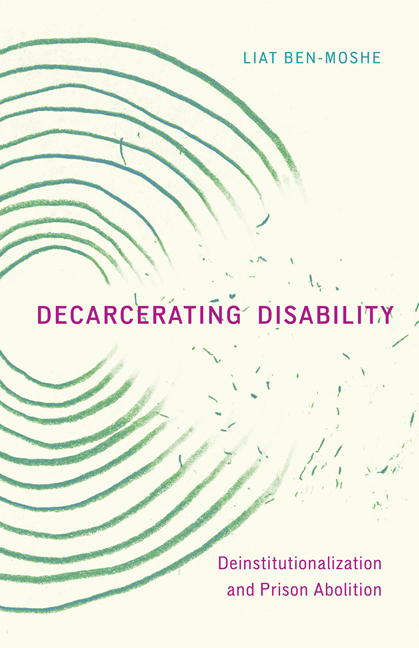
[ID: A book cover. The background is cream, with several green circles on the left side. In the centre, the circles appear to be crumbling away. Text on the cover reads:
The authors name “Liat Ben-Moshe” in small, blue capitals in the upper right corner of the cover,
The title “Decarcerating Disability” in large purple capitals across the centre of the cover,
The subtitle “Deinstitutionalization and Prison Abolition” in small, purple writing in the lower right corner of the cover. /end]
Content Warning:
TBD
Summary:
Prison abolition and decarceration are increasingly debated, but it is often without taking into account the largest exodus of people from carceral facilities in the twentieth century: the closure of disability institutions and psychiatric hospitals. Decarcerating Disability provides a much-needed corrective, combining a genealogy of deinstitutionalization with critiques of the current prison system. Liat Ben-Moshe provides groundbreaking case studies that show how abolition is not an unattainable goal but rather a reality, and how it plays out in different arenas of incarceration–antipsychiatry, the field of intellectual disabilities, and the fight against the prison-industrial complex. Ben-Moshe discusses a range of topics, including why deinstitutionalization is often wrongly blamed for the rise in incarceration; who resists decarceration and deinstitutionalization, and the coalitions opposing such resistance; and how understanding deinstitutionalization as a form of residential integration makes visible intersections with racial desegregation. By connecting deinstitutionalization with prison abolition, Decarcerating Disability also illuminates some of the limitations of disability rights and inclusion discourses, as well as tactics such as litigation, in securing freedom.
Notes:
Ben-Moshe also edited the collection “Disability Incarcerated: Imprisonment and Disability in the United States and Canada”.
Archivist Comments:
For the most part this seems to have been very well received, however there have been some calls for improvement in the pacing and the overly academic wording of the book as a whole.
 The Disability Book Archive
Leave a comment