
Title: Disfigured
Subtitle: On Fairy Tales, Disability and Making Space
Author: Amanda Leduc
Other Contributors: N/A
Subject: Fairy Tales, Disability Representation, Disability Justice, Disability Awareness
Publisher: Coach House Books
Published: 2020
ISBN/DOI/EISBN: 978-1-5524-5395-7
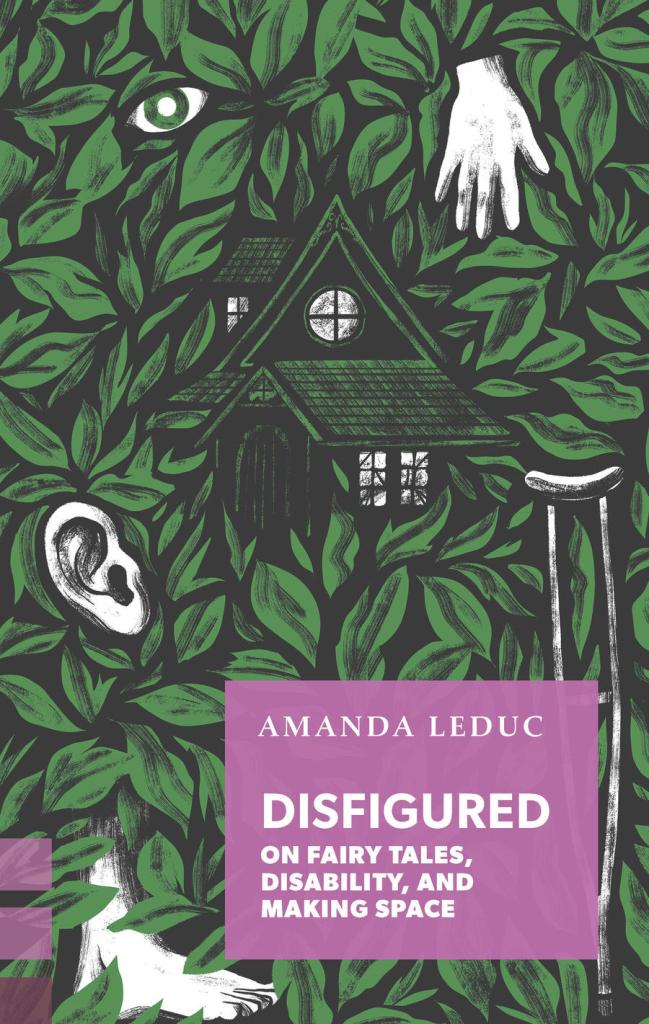
[ID: A book cover. The background is back and covered in painted green leaves. In the centre, the outline of a green house. In the lower left corner, a white foot can be seen. Lower centre left of the cover, below the house, a white ear can be seen. In the top left corner, a white eye with green iris can be seen. In the top right corner, a white hand can be seen. In lower right corner, stretching up the right side of the cover, a white underarm crutch can be seen.
Overlaying the crutch, a purple box with white writing. The writing reads:
The authors name “Amanda Leduc” in white capitals.
The title “Disfigured” in slightly bigger, white capitals.
The subtitle “On Fairy Tales, Disability and Making Space” in slightly smaller white capitals. /end]
Content Warning:
- Ableism
- Bullying
- Medical Content
- Suicidal Thoughts
- Mental Illness
- Rape
Summary:
In fairy tales, happy endings are the norm—as long as you’re beautiful and walk on two legs. After all, the ogre never gets the princess. And since fairy tales are the foundational myths of our culture, how can a girl with a disability ever think she’ll have a happy ending?
By examining the ways that fairy tales have shaped our expectations of disability, Disfigured will point the way toward a new world where disability is no longer a punishment or impediment but operates, instead, as a way of centering a protagonist and helping them to cement their own place in a story, and from there, the world. Through the book, Leduc ruminates on the connections we make between fairy tale archetypes—the beautiful princess, the glass slipper, the maiden with long hair lost in the tower—and tries to make sense of them through a twenty-first-century disablist lens. From examinations of disability in tales from the Brothers Grimm and Hans Christian Andersen through to modern interpretations ranging from Disney to Angela Carter, and the fight for disabled representation in today’s media, Leduc connects the fight for disability justice to the growth of modern, magical stories, and argues for increased awareness and acceptance of that which is other—helping us to see and celebrate the magic inherent in different bodies.
Notes:
This book was was shortlisted for the 2020 Governor General’s Award in Nonfiction and longlisted for the 2020 Barbellion Prize.
Archivist Comments:
This one is now firmly on my personal tbr. I found it just after finishing a big essay on a similar topic and got very excited about it.
I’ve tagged it “adult” as well as “misc” in the age category. Unlike a lot of other non-fiction books, I keep seeing an actual age rating for this one so I thought I’d include it.
 The Disability Book Archive
Leave a comment