
Title: Jubilee
Subtitle: The First Therapy Horse and an Olympic Dream
Author: KT Johnston
Other Contributors: Anabella Ortiz
Subject: Polio, Lis Hartel, The Olympics, Recovery, Horses, Dressage
Publisher: Capstone
Published: 2022
ISBN/DOI/EISBN: 978-1-6844-6255-1
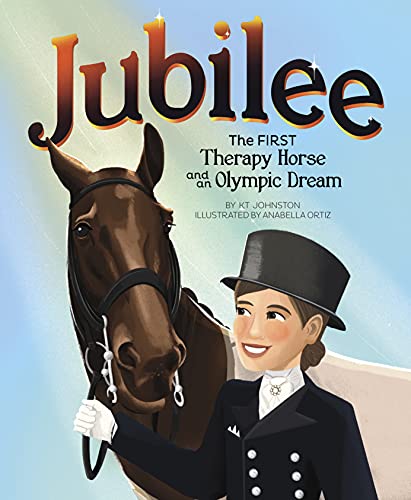
[ID: A book cover. Art reaching from the right corner to the centre of the cover depicts a brown horse being led by a woman in a black dressage suit. They are against a light blue background, designed to look like a beam of light is shining on them. Above them, text reads:
The title “Jubilee” in large dark red writing,
The subtitle “The First Therapy and an Olympic Dream” immediately below this in smaller black writing.
“By KT Johnson” and “Illustrated by Anabella Ortiz” immediately below this in smaller, black capitals. /end]
Content Warning:
TBD
Summary:
A Junior Library Guild exclusive selection!
Lis Hartel became paralyzed after contracting polio in 1944. Her dreams of riding horses and competing in the sport of dressage were shattered. After months in the hospital, doctors told her she’d never ride again. Lis tried anyway. How do you stay on a horse without using your legs? How do you give the subtle cues needed in dressage with limited mobility? With hard work—and an unlikely horse named Jubilee. After years of training together and creating a new way of communicating, Lis and Jubilee danced into the competition ring, and eventually all the way to the Olympics. Lis Hartel became the first woman with a disability to compete in the Olympics, and the first woman to stand beside men on the Olympic winner’s podium for equestrian sports.
Notes:
In 1952, Danish Olympian Lis Hartel became one of the first women to compete in modern equestrian sport at the Summer Olympics, as well as the first female equestrian to win a medal in individual dressage. She would again win this medal during the 1956 Olympics. She had become paralysed from the waist down after contracting Polio at the age of 23.
Archivist Comments:
Someone once asked me what could possibly be taught if disability history was an actual topic in school. I reckon this fits the bill perfectly.
 The Disability Book Archive
Leave a comment