
Title: Language Deprivation and Deaf Mental Health
Subtitle: N/A
Author: Neal S. Glickman, Wyatte C. Hall
Other Contributors: N/A
Subject: Language Development, Inaccessibility, Deafness, Language and Communication, Language Deprivation
Publisher: Routledge
Published: 2018
ISBN/DOI/EISBN: 978-1-1387-3539-2
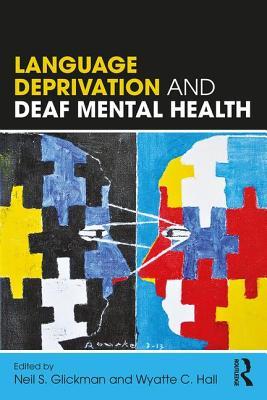
[ID: A book cover. It is divided into three sections. The top section is black with text that reads:
“Language Deprivation” in large, bold, yellow capitals
“And” in large, thin, white capitals
“Deaf Mental Health” in large, bold, white capitals.
Below this, a large section split vertically, with black on the left and blue on the right. On each half, there is a face made up of different coloured jigsaw pieces. The faces are staring at each other.
Below this, at the bottom of the cover, a dark blue banner with text. It reads:
“Edited by Neil S. Glickman and Wyatte C. Hall”.
In the bottom right corner, a stylised capitals “R”. /end]
Content Warning:
TBD
Summary:
Language Deprivation and Deaf Mental Health explores the impact of the language deprivation that some deaf individuals experience by not being provided fully accessible language exposure during childhood. Leading experts in Deaf mental health care discuss the implications of language deprivation for a person’s development, communication, cognitive abilities, behavior, and mental health. Beginning with a groundbreaking discussion of language deprivation syndrome , the chapters address the challenges of psychotherapy, interpreting, communication and forensic assessment, language and communication development with language-deprived persons, as well as whether cochlear implantation means deaf children should not receive rich sign language exposure. The book concludes with a discussion of the most effective advocacy strategies to prevent language deprivation. These issues, which draw on both cultural and disability perspectives, are central to the emerging clinical specialty of Deaf mental health.
Notes:
There is a kindle edition.
Archivist Comments:
I don’t know enough about this book to comment on it, though it looks like Glickman has a lot of literature out in this area.
 The Disability Book Archive
Leave a comment