
Title: The Minority Body
Subtitle: A Theory of Disability
Author: Elizabeth Barnes
Other Contributors: N/A
Subject: Disability Pride, Disability Rights, Philosophy, Physical Disability
Publisher: Oxford University Press
Published: 2016
ISBN/DOI/EISBN: 978-0-1987-3258-7
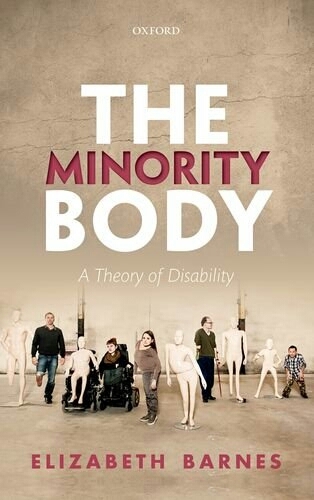
[ID: A book cover. The background is a light brown. The name of the publisher “Oxford” is at the top in small white capitals.
Below this, the title “The Minority Body” in large capitals. “The” and “Body” are white. “Minority” is red.
Below this, a photograph of five, visibly disabled people- an amputee, a wheelchair user, someone with a curved spine, a crutch user, and another physically disabled individual. Beside each person is a mannequin posed in exactly the same position.
Below this, the author’s name “Elizabeth Barnes” in slightly smaller red capitals. /end]
Content Warning:
TBD
Summary:
Elizabeth Barnes argues compellingly that disability is primarily a social phenomenon–a way of being a minority, a way of facing social oppression, but not a way of being inherently or intrinsically worse off. This is how disability is understood in the Disability Rights and Disability Pride movements; but there is a massive disconnect with the way disability is typically viewed within analytic philosophy. The idea that disability is not inherently bad or sub-optimal is one that many philosophers treat with open skepticism, and sometimes even with scorn. The goal of this book is to articulate and defend a version of the view of disability that is common in the Disability Rights movement. Elizabeth Barnes argues that to be physically disabled is not to have a defective body, but simply to have a minority body.
Notes:
Barnes is a professor of philosophy at the University of Virgina.
Archivist Comments:
I’m pretty sure I’ve read part of this book but I can’t remember. I don’t actually know too much about it.
 The Disability Book Archive
Leave a comment