
Title: No Right to Be Idle
Subtitle: The Invention of Disability, 1840s-1930s
Author: Sarah F. Rose
Other Contributors: N/A
Subject: Disability Studies, History, American History, Disability History, Politics, Sociology
Publisher: The University of North Carolina Press
Published: 2017
ISBN/DOI/EISBN: 978-1-4696-2489-1
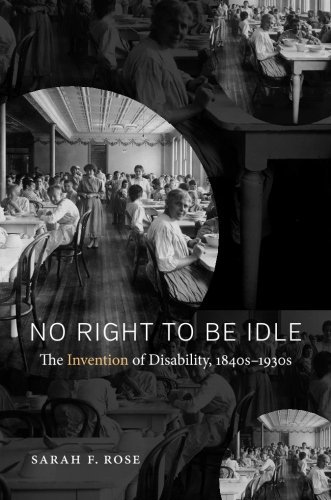
[ID: A book cover. The background is a dark, black and white photograph of a large group of people in a hall. The majority of them are sitting tables. Over this image, 3 large circles showing smaller, lighter versions of the same photograph across the cover. Text in the lower centre of the image reads:
The title “No Right to Be Idle” in white capitals.
The subtitle “The Invention of Disability, 1840s-1930s” immediately below this, in smaller, white writing. Except for “invention” which is yellow.
In the lower left corner, the author’s name “Sarah F. Rose” in small white capitals. /end]
Content Warning:
- Ableism
- Historical Ableism
- Politics
- TBC
Summary:
During the late nineteenth and early twentieth centuries, Americans with all sorts of disabilities came to be labeled as “unproductive citizens.” Before that, disabled people had contributed as they were able in homes, on farms, and in the wage labor market, reflecting the fact that Americans had long viewed productivity as a spectrum that varied by age, gender, and ability. But as Sarah F. Rose explains in No Right to Be Idle , a perfect storm of public policies, shifting family structures, and economic changes effectively barred workers with disabilities from mainstream workplaces and simultaneously cast disabled people as morally questionable dependents in need of permanent rehabilitation to achieve “self-care” and “self-support.”
By tracing the experiences of policymakers, employers, reformers, and disabled people caught up in this epochal transition, Rose masterfully integrates disability history and labor history. She shows how people with disabilities lost access to paid work and the status of “worker–a shift that relegated them and their families to poverty and second-class economic and social citizenship. This has vast consequences for debates about disability, work, poverty, and welfare in the century to come.
Notes:
This book was awarded the Phillip Taft Labor History Book Award in 2018.
Archivist Comments:
I can’t find much information on content warnings, so just let me know if I missed anything. I saw a comment saying that this was the author’s doctoral dissertation originally, but I don’t know how true that it is.
 The Disability Book Archive
Leave a comment