
Title: Nothing About Us Without Us
Subtitle: Disability Oppression and Empowerment
Author: James I. Charlton
Other Contributors: N/A
Subject: Disability Oppression, Disability Rights, Disability Activism, The Global Disability Experience
Publisher: University of California Press
Published: 2000
ISBN/DOI/EISBN: 978-0-5202-2481-0
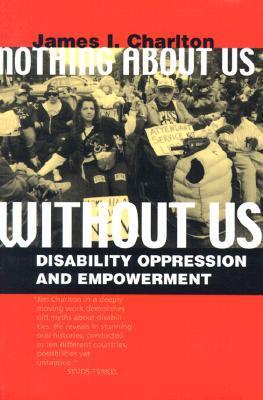
[ID: A book cover. The background is largely red, with a large yellow tone photograph of a protest across the centre. The author’s name, “James I. Charlton” is at the top of the photograph, in small black writing.
Directly below this, at the top of the photograph, the first half of the title “Nothing About Us” in larger white capitals.
At the bottom of the photograph, the second half of the title “Without Us”, also in large white capitals.
Directly below this, the subtitle “Disability Oppression and Empowerment” in smaller white capitals. /end]
Content Warning:
- Oppression
- TBD
Summary:
James Charlton has produced a ringing indictment of disability oppression, which, he says, is rooted in degradation, dependency, and powerlessness and is experienced in some form by five hundred million persons throughout the world who have physical, sensory, cognitive, or developmental disabilities. Nothing About Us Without Us is the first book in the literature on disability to provide a theoretical overview of disability oppression that shows its similarities to, and differences from, racism, sexism, and colonialism. Charlton’s analysis is illuminated by interviews he conducted over a ten-year period with disability rights activists throughout the Third World, Europe, and the United States.
Charlton finds an antidote for dependency and powerlessness in the resistance to disability oppression that is emerging worldwide. His interviews contain striking stories of self-reliance and empowerment evoking the new consciousness of disability rights activists. As a latecomer among the world’s liberation movements, the disability rights movement will gain visibility and momentum from Charlton’s elucidation of its history and its political philosophy of self-determination, which is captured in the title of his book.
Nothing About Us Without Us expresses the conviction of people with disabilities that they know what is best for them. Charlton’s combination of personal involvement and theoretical awareness assures greater understanding of the disability rights movement.
Notes:
Apparently, the author makes quite clear in the beginning of this book that it mainly focuses on physical disabilities.
Archivist Comments:
I don’t know enough about this book to really comment on it. I do like the whole “interview” idea though.
 The Disability Book Archive
Leave a comment