
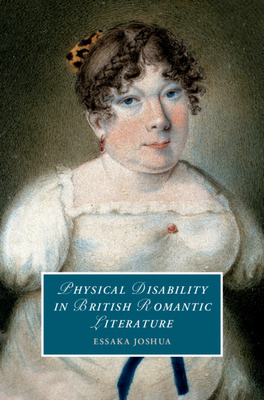
Title: Physical Disability in British Romantic Literature
Subtitle: N/A
Author: Essaka Joshua
Other Contributors: N/A
Subject: Physical Disability, English Literature, Romantic Literature, The Romantic Period, Feminism, Literature Studies, Deformity
Publisher: Cambridge University Press
Published: 2020
ISBN/DOI/EISBN: 978-1-1088-3670-8
[ID: A book cover. The background is a portrait by Sarah Biffen. It shows the upper half of a white woman in a white dress, with brown curly hair tied back, red earrings and and blue sash around her wrist. She has no arms. There is a blue box at the bottom of the cover. It has a white outline and white, italicised text. The text reads:
The title “Physical Disability in British Romantic Literature” in caps.
The author’s name “Essaka Joshua” immediately below this in smaller, non-italicised yellow caps. /end]
Content Warning:
TBD
Summary:
The modern concept of disability did not exist in the Romantic period. This study addresses the anachronistic use of ‘disability’ in scholarship of the Romantic era, providing a disability studies theorized account that explores the relationship between ideas of function and aesthetics. Unpacking the politics of ability, the book reveals the centrality of capacity and weakness concepts to the egalitarian politics of the 1790s, and the importance of desert theory to debates about sentiment and the charitable relief of impaired soldiers. Clarifying the aesthetics of deformity as distinct from discussions of ability, Joshua uncovers a controversy over the use of deformity in picturesque aesthetics, offers accounts of deformity that anticipate recent disability studies theory, and discusses deformity and monstrosity as a blended category in Frankenstein. Setting aside the modern concept of disability, Joshua cogently argues for the historical and critical value of period-specific terms.
Notes:
Essaka Joshua is an English Professor at the University of Notre Dame, Indiana.
Archivist Comments:
There’s a good essay on Frankenstein in here. This book was suggested to me by my university tutor when I first brought up the idea of studying something related to disability for my dissertation. It’s great honestly. (Totally not biased /s)
Jokes aside, I think it’s an insightful look into an area of literary study that is still underdeveloped and looking for nuance. Topics discussed in this book include works by Mary Wollstonecraft, William Godwin, William Wordsworth, and, of course, Mary Shelley’s Frankenstein.
Also, I searched so hard to find the name of that painting. If you want more information on Sarah Biffen, please see here, here and here.
 The Disability Book Archive
Leave a comment