
Title: Unmasking Autism
Subtitle: Discovering the New Faces of Neurodiversity
Author: Devon Price
Other Contributors: N/A
Subject: Autism, Masking, Marginalisation, The Disabled Experience, Self-Expression, Gender Identity
Publisher: Harmony
Published: 2022
ISBN/DOI/EISBN: 978-0-5932-3523-2
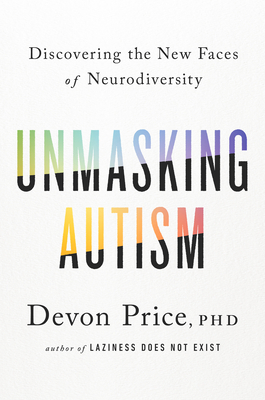
[ID: A book cover. The background is white and text is written from the top to the bottom of the cover. It reads:
The subtitle “Discovering the New Faces of Neurodiversity” in black font.
The title “Unmasking Autism” across the centre in large capitals. The letters are half black, half coloured with a rainbow gradient.
The author’s name “Devon Price, PHD” directly below this in slightly smaller black font.
“Author of ‘Laziness Does Not Exist’” directly below this in smaller black font. “Author of” is lowercase and italicised. “Laziness Does Not Exist” is written in capitals. /end]
Content Warning:
- Ableism
- Racism
- Transphobia
- Addiction
- Bullying
- Self-Harm
- References to Sex Work
Summary:
A deep dive into the spectrum of Autistic experience and the phenomenon of masked Autism, giving individuals the tools to safely uncover their true selves while broadening society’s narrow understanding of neurodiversity“A remarkable work that will stand at the forefront of the neurodiversity movement.”—Barry M. Prizant, PhD, CCC-SLP, author of Uniquely A Different Way of Seeing Autism
For every visibly Autistic person you meet, there are countless “masked” Autistic people who pass as neurotypical. Masking is a common coping mechanism in which Autistic people hide their identifiably Autistic traits in order to fit in with societal norms, adopting a superficial personality at the expense of their mental health. This can include suppressing harmless stims, papering over communication challenges by presenting as unassuming and mild-mannered, and forcing themselves into situations that cause severe anxiety, all so they aren’t seen as needy or “odd.” In Unmasking Autism, Dr. Devon Price shares his personal experience with masking and blends history, social science research, prescriptions, and personal profiles to tell a story of neurodivergence that has thus far been dominated by those on the outside looking in. For Dr. Price and many others, Autism is a deep source of uniqueness and beauty. Unfortunately, living in a neurotypical world means it can also be a source of incredible alienation and pain. Most masked Autistic individuals struggle for decades before discovering who they truly are. They are also more likely to be marginalized in terms of race, gender, sexual orientation, class, and other factors, which contributes to their suffering and invisibility. Dr. Price lays the groundwork for unmasking and offers exercises that encourage self-expression, • Celebrating special interests• Cultivating Autistic relationships• Reframing Autistic stereotypes• And rediscovering your values
It’s time to honor the needs, diversity, and unique strengths of Autistic people so that they no longer have to mask—and it’s time for greater public acceptance and accommodation of difference. In embracing neurodiversity, we can all reap the rewards of nonconformity and learn to live authentically, Autistic and neurotypical people alike.
Notes:
There is an ebook/Kindle version.
I think there’s an audiobook.
Archivist Comments:
I’ve tagged this as “transgender” because, from what I’ve seen, the author talks quite a bit about the intersections of autism, gender and sexuality, as well as their own trans experiences. Correct me if I’m wrong.
There are a lot of reviews for this book, and some of the more negative ones seem to be lamenting the “left-wing” political side of the book. I saw someone even say that some of the references and topics discussed were too “chronically online”. A lot of the book’s criticism is directed towards its discussions of gender and sex work.
But, a lot of reviews have said it was a “good introduction” into autism and masking, especially from a neurotypical standpoint, and praise has been directed towards the author’s “vulnerability” in sharing their story and personal experiences in the book. I think the author has also interviewed other autistic people for the purpose of this book (I’ll update with a list if I can find one), and people have referenced an effort to highlight the differences in autistic experience.
 The Disability Book Archive
Leave a comment