
Title: The Architecture of Disability
Subtitle: Buildings, Cities, and Landscapes beyond Access
Author: David Gissen
Other Contributors: N/A
Subject: Disability, Architecture, Accessibility, Disability Studies, Design
Publisher: University of Minnesota Press
Published: 2023
ISBN/DOI/EISBN: 978-1-5179-1250-5
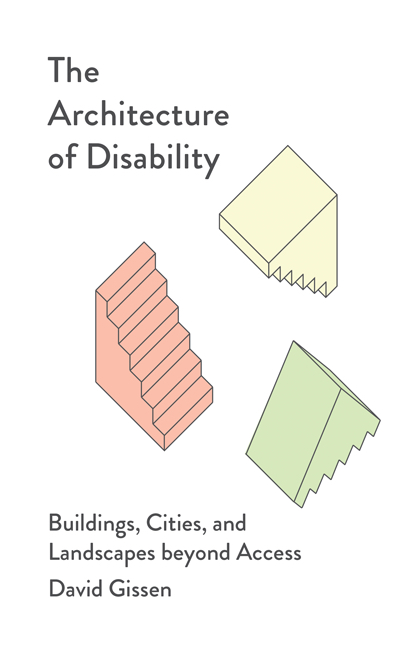
[ID: A book cover. In the top left corner, the title “The Architecture of Disability” is written in large black font. Below this, across the centre of the book, three shapes, appearing to be stairs, in the colours red, green and yellow, and rotated to different angles. Below this, in the lower left corner, in a smaller black font to the title, the subtitle “Buildings, Cities and Landscapes beyond Access”, and the authors name “David Gissen”. All of this is over a plain white background. /end]
Content Warning:
Summary:
A radical critique of architecture that places disability at the heart of the built environment
Disability critiques of architecture usually emphasize the need for modification and increased access, but The Architecture of Disability calls for a radical reorientation of this perspective by situating experiences of impairment as a new foundation for the built environment. With its provocative proposal for “the construction of disability,” this book fundamentally reconsiders how we conceive of and experience disability in our world.
Stressing the connection between architectural form and the capacities of the human body, David Gissen demonstrates how disability haunts the history and practice of architecture. Examining various historic sites, landscape designs, and urban spaces, he deconstructs the prevailing functionalist approach to accommodating disabled people in architecture and instead asserts that physical capacity is essential to the conception of all designed space.
By recontextualizing the history of architecture through the discourse of disability, The Architecture of Disability presents a unique challenge to current modes of architectural practice, theory, and education. Envisioning an architectural design that fully integrates disabled persons into its production, it advocates for looking beyond traditional notions of accessibility and shows how certain incapacities can offer us the means to positively reimagine the roots of architecture.
Notes:
The writer of this book, David Gissen, is a disabled designer and architecture historian.
Archivist Comments:
I couldn’t actually find too much on this book at first, but I’ve done a bit of digging.
A few comments I’ve seen suggest that this is a book relatively academic in tone, which makes sense considering it apparently takes a bit of a philosophical approach to accessibility.
It suggests that architecture can be more accessible if disabled people are already at the centre of construction, rather than just an afterthought, by replacing the abled model of construction with a more disability-centric one.


Leave a Reply